
The Wooster Group’s
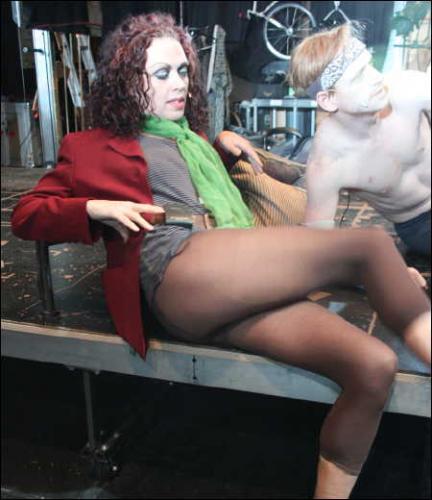
Version of Tennessee Williams’ Vieux Carré recently stopped at the
Harbourfront Centre World Stage on March 28-31, 2012. DART’s connection to the production was a panel
discussion moderated by Praxis faculty member Dr. Natalie Alvarez in conjunction
with the University of Toronto. Its
relevance to our production of The Blue Room stems from its somewhat similar
narrative structure of a series of scenes or vignettes, although their
structures are quite different: Vieux Carré
is connected by a central protagonist/observer, while The Blue Room forms a ring of connecting scenes like a chain or a
game of dominoes.
Vieux Carré is an
autobiographical play based loosely on Williams’ experiences at a boarding
house in New Orleans’ French Quarter. It
is a “memory play” much like The Glass
Menagerie, with The Writer recalling his past and his various encounters
with his land lady and fellow tenant as he comes to terms with his sexuality.
What it has in common with The Blue Room (besides its episodic structure) are its sketchy, caricature-like
characters (while most have names, the anonymous central character is much like
the archetypes of The Blue Room), and
its overt exploration of sexuality (though in this case homosexuality is
explored, while The Blue Room’s text
does not address it).
Some of the reviews from the Wooster production mirror
critics concerns over The Blue Room;
Paula Citron called Vieux Carré “an
endless, perhaps, even mindless, bore”[1] reflecting the impression that NYC
critic Ben Brantley had with Hare’s play; or the Village Voice noting that “the
piece has strong scenes filled with pungent language, but never fully
coalesces.”[2] This demonstrates the
challenges facing plays with multiple scenes and characters that may have
little in common between them: there are fewer opportunities at textually-based
character development that comes more easily in traditional narratives.
The reviews haven’t all been bad, however, in fact they were generally favourable. J. Kelly Nestruck
observed that on “one level, the the Wooster Group's approach to the material
seems simply a fancy way of showing off by rubbing your belly and patting your
head at the same. From an aesthetic point of view, however, I found the unorthodox
process informed the play in surprising ways that that emphasized the fragility
of our remembrances of things past in the era of the online taunt: ‘Pics or it
didn't happen.’”[3] The challenge for
The Blue Room is to find ways to crystallize its exploration of the disconnect between sexual fantasy and reality
without overemphasizing the inherent “sameness” of each scene and keep the
production compelling for audiences.
Harbourfront Centre: http://www.harbourfrontcentre.com/worldstage2012/thewoostergroup.cfm
The Wooster Group's production page: http://thewoostergroup.org/twg/twg.php?vieux-carre/
The Wooster Group's video blog "dailies" from the production and tour, including their sojourn in Toronto: http://thewoostergroup.org/blog/dailies/vieux-carre/


Interviews of the director and cast:
Elizabeth LeCompte (classical TV)
The original Mrs. Wire: Sylvia Miles (Edinburgh Festivals)

No comments:
Post a Comment