Hyperbolic geometry is a form of non-Euclidean geometry. According to WolframMathworld, Euclidean geometry consists of 5 postulates:
- A straight line segment can be drawn joining any two points.
- Any straight line segment can be extended indefinitely in a straight line.
- Given any straight line segment, a circle can be drawn having the segment as radius and one endpoint as center.
- All right angles are congruent.
- If two lines are drawn which intersect a third in such a way that the sum of the inner angles on one side is less than two right angles, then the two lines inevitably must intersect each other on that side if extended far enough. This postulate is equivalent to what is known as the parallel postulate.[1]
For any infinite straight line L and any point P not on it, there are many other infinitely extending straight lines that pass through P and which do not intersect L.[2]Also, while spherical geometry has a constant positive curvature (capable of creating perfect circles or "daisy-chains", hyperbolic geometry relies on negative curvature (the concept of n-space). A way to visualize this geometric theorem is through the creation of hyperbolic spaces, which are the models of this geometry. Rather than perfect circles of spheres, these models generate curving patterns that grow exponentially as the size of the radius increase. You will get shapes that resemble coral reefs.


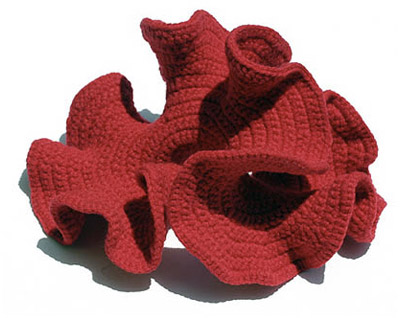
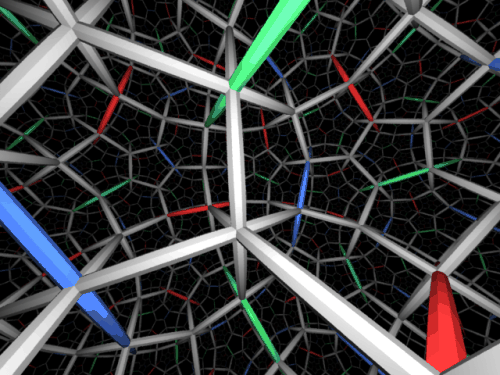


Here is a link to "math" artist Vi Hart: http://vihart.com/everything/

No comments:
Post a Comment